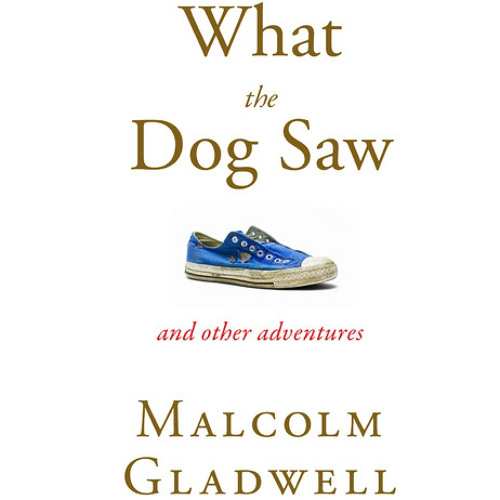
What the Dog Saw: And Other Adventures


Malcolm Gladwell has written four thought-provoking books on the human condition and related to practical subjects and topics but what has been different about his perspectives is that he has included in the equation a critical eye within a case study approach. And he himself can be topic of discussion, especially with What the Dog Saw and Other Adventures. The book may be a retrospective of his past writings that were published in The New Yorker in 1996 and to 2008. If one has not read or come across any of the articles, they are a very insightful collection.


What the Dog Saw never disappoints for readers that have grown accustomed to Gladwell’s writings. Two points that one may consider before reading the book, the interesting part about the book is that it provides first-time readers a sample of his writing, and second, it clearly shows how far he has come but continues to move forward in his perspectives that are open to new ideas. But one recommendation, if one has not already read his previous books, it is highly encouraged.


In the past decade, Malcolm Gladwell has written three books that have radically changed how we understand our world and ourselves: The Tipping Point; Blink; and Outliers. Now, in What the Dog Saw, he brings together, for the first time, the best of his writing from TheNew Yorker over the same period.


Here is the bittersweet tale of the inventor of the birth control pill, and the dazzling inventions of the pasta sauce pioneer Howard Moscowitz. Gladwell sits with Ron Popeil, the king of the American kitchen, as he sells rotisserie ovens, and divines the secrets of Cesar Millan, the "dog whisperer" who can calm savage animals with the touch of his hand. He explores intelligence tests and ethnic profiling and "hindsight bias" and why it was that everyone in Silicon Valley once tripped over themselves to hire the same college graduate.

Comments

Popular posts from this blog

The book Thief

When Death has a story to tell, you listen. It is 1939. Nazi Germany. The country is holding its breath. Death has never been busier and will become busier still. Liesel Meminger is a foster girl living outside of Munich, who scratches out a meager existence for herself by stealing when she encounters something she can’t resist–books. With the help of her accordion-playing foster father, she learns to read and shares her stolen books with her neighbors during bombing raids as well as with the Jewish man hidden in her basement. In superbly crafted writing that burns with intensity, award-winning author Markus Zusak, author of I Am the Messenger, has given us one of the most enduring stories of our time. D O W N L O A D   T H E    T H I E F  

Long Walk To Freedom

Nelson Mandela was one of the great moral and political leaders of his time: an international hero whose lifelong dedication to the fight against racial oppression in South Africa won him the Nobel Peace Prize and the presidency of his country. After his triumphant release in 1990 from more than a quarter-century of imprisonment, Mandela was at the center of the most compelling and inspiring political drama in the world. As president of the African National Congress and head of South Africa's antiapartheid movement, he was instrumental in moving the nation toward multiracial government and majority rule. He is still revered everywhere as a vital force in the fight for human rights and racial equality. Long Walk to Freedom  is his moving and exhilarating autobiography, destined to take its place among the finest memoirs of history's greatest figures. Here for the first time, Nelson Rolihlahla Mandela told the extraordinary story of his life -- an epic of struggle, setback, renew...

The Laws of Human Nature

Robert Greene is a master guide for millions of readers, distilling ancient wisdom and philosophy into essential texts for seekers of power, understanding and mastery. Now he turns to the most important subject of all - understanding people's drives and motivations, even when they are unconscious of them themselves. We are social animals. Our very lives depend on our relationships with people. Knowing why people do what they do is the most important tool we can possess, without which our other talents can only take us so far. Drawing from the ideas and examples of Pericles, Queen Elizabeth I, Martin Luther King Jr, and many others, Greene teaches us how to detach ourselves from our own emotions and master self-control, how to develop the empathy that leads to insight, how to look behind people's masks, and how to resist conformity to develop your singular sense of purpose. Whether at work, in relationships, or in shaping the world around you, The Laws of Human Nature offers bri...